
Understanding the Four Main Types of Welding
Welding is a wide field with several techniques suited to different materials, environments, and quality requirements. Choosing the right method can affect everything from speed and cost to strength and appearance. Below is an overview of four commonly used welding processes and where they are typically applied.
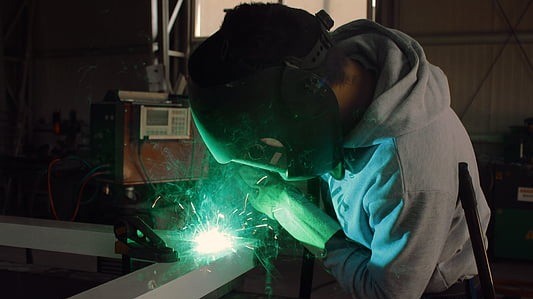
TIG welding, also known as Tungsten Inert Gas welding, uses a non-consumable tungsten electrode to create the arc, while a filler rod is added manually by the welder. The weld area is protected by a shielding gas, most often argon, although helium mixtures are sometimes used. This process is valued for its precision and cleanliness. It allows excellent control of heat input and produces high-quality welds with a neat appearance. It is commonly used on stainless steel, aluminium and its alloys, titanium, and thin carbon steel. Because of its accuracy and finish, TIG welding is often found in aerospace components, sanitary pipework in the food and beverage sector, custom automotive fabrication, and any high-specification work where visual quality matters. The welds are strong and clean, and the method is ideal for thin materials. However, it is relatively slow, requires significant skill, and is not well suited to dirty or corroded surfaces.
MIG welding, or Metal Inert Gas welding, uses a continuously fed wire electrode and shielding gas to protect the weld pool. The process is semi-automatic and generally uses argon and carbon dioxide mixtures. It is widely chosen for its speed and efficiency and is easier to learn compared to TIG welding. MIG welding provides a practical balance between productivity and weld quality and is commonly used on mild steel, stainless steel, and aluminium. Typical applications include general fabrication, automotive manufacturing, structural steelwork, shipbuilding, and workshop production settings. The process allows consistent welds and high productivity, making it suitable for long weld runs with less operator skill required. On the other hand, the shielding gas makes it unsuitable for windy outdoor conditions, it produces more spatter than TIG welding, and it offers less precise heat control.
Stick welding, often referred to as Shielded Metal Arc Welding, uses a flux-coated consumable electrode that creates its own protective gas when burned, meaning no external shielding gas is required. This makes it a highly versatile and robust method that performs well in harsh environments. It is commonly used for carbon steel and low-alloy steel and is frequently applied on construction sites and in maintenance or repair work where materials may be dirty or rusty. Stick welding equipment is simple and portable, works reliably in wind and rain, and delivers strong penetration. The drawbacks include slower progress compared to MIG welding, the need to replace electrodes regularly, and additional weld clean-up due to slag.
Laser welding uses a high-energy laser beam to fuse materials together and is often automated or integrated into robotic systems. The heat source is extremely concentrated, allowing very precise welds with minimal heat-affected zones. This process is used on stainless steel, aluminium, nickel alloys, and thin or small-scale components. Industries such as automotive manufacturing, medical device production, electronics, and aerospace rely on laser welding for high-volume or high-precision work. The advantages include very fast welding speeds, low distortion, and consistent, repeatable results that suit automation. The main limitations are the high equipment cost, the need for precise joint preparation, limited tolerance for gaps, and restrictions on material thickness.